The Higher and Lower Mind
There’s a part of the mind which knows whatever is going on, whatever has gone on, and whatever will go on in this universe. That part of the mind is very reserved and uninvolved — it does not get entangled in the day-to-day activities of logic and reasoning. All those activities belong to the smaller mind. The smaller part of the mind — the one that deals with worldly things — does not know everything. That is why it is always curious, always seeking to know, always restless but the higher part of the mind is not curious about anything, because it already knows everything. So, there is a polarity — two opposites within us: the lower part of the mind that knows nothing, and the higher part that knows everything. Now, under certain circumstances, knowledge from the higher mind can flow into the lower mind. When the conditions are right, the knowledge is released and flows downward. When that happens, we call it intuition—or “inner-tuition”, or “inner guidance”—because the part which knows releases its knowing to the part which does not know.
The Source of Knowing
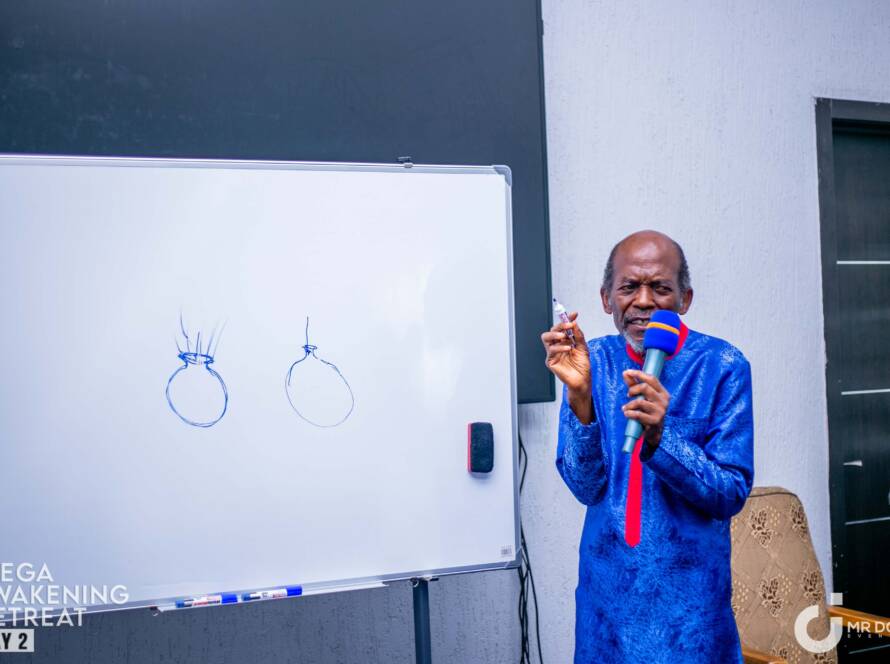
In the beginning we have Spirit, and it is Spirit that is truly omniscient. ‘Omniscience’ means ‘to know everything’. The mind itself does not possess knowledge on its own; it receives knowing from Spirit. A portion of the mind lies very close to Spirit, and that portion is constantly receiving from the omniscient Source. Let us use an image. Imagine the mind as a room. The door of that room is the part in contact with Spirit; the window is the part open to the world. The air moving through the room is knowledge. The big door allows a great current of air to flow in and out, but the window gives only a small opening. If the window is shut, air cannot flow freely, even though the door stands wide open.
This analogy also applies to the human mind. The higher part, close to Spirit, is always open. But those who live only in the lower mind—the “sleeping souls”—have closed the window. Therefore, no flow occurs. Intuition can take place only when the lower mind has been prepared. When it has been calmed and opened, then the current of wisdom can pass through.
Intellect and Intuition
The difference between intellect and intuition is very clear. The intellect depends on intelligence — but the lower mind, by itself, has no true intelligence that is why it continually seeks knowledge by collecting facts, making observations, and analyses. Intelligence flows only from the higher mind, and that can happen only when the lower mind has gone through a process of quieting.
Take this example. If you have a source of abundant water, it will flow naturally toward a lower level. But if the ground is high or uneven, the flow stops. In the same way, wisdom, great knowledge, and higher intelligence from the higher mind flow into the lower only when the lower mind is low, humble, and calm. When the lower mind is active, restless, and noisy, the higher mind cannot descend. When the field is raised, there is no flow.
Intuition is always available — always ready — but the lower mind must be stilled. This is why throughout history, scientists, artists, poets, musicians, and all creators have depended on intuition. When they calm the objective mind, the flow begins. Many have discovered that when they struggle and think too much, results do not come. But when they relax, when they breathe, when the mind grows still, insight appears.
The Connection Between Mind and Breath
Intuition is of absolute importance to our lives. The objective mind, also known as the lower mind, creates every problem we encounter, while the higher mind provides the solutions. You may have heard the saying, “The mind that created the problem cannot be the same mind that solves it.”
When we rely solely on the lower mind, we create and multiply problems. But whenever a true solution comes, it is because a measure of intuition has been introduced, whether consciously or unconsciously. Observe this: when a person is worrying, thinking, thinking, and overthinking, at a certain point he exhales deeply — hmmph! At that moment, the breath stabilises, the mind settles, and suddenly the answer comes.
This shows the intimate connection between breath and mind. When the breath is disturbed, the mind is disturbed. When the breath becomes steady, the mind becomes peaceful. The two are reflections of each other. So, if you wish to calm the objective mind, approach it through the breath. If you try to quiet the mind directly, it resists, but through your breath, you can trick it—gently. Take a deep in-breath, then breathe out slowly — hmmmmph. After a strong out-breath, there is a moment of silence. In that silence, the lower mind subsides, and the higher mind begins to shine.
The Mystery of Breath and Death
Breath is the cord that ties us to this world. When a baby is born, its first act is to breathe in; that breath pulls the soul fully into the body, and then after, the lower mind begins to form. When a person dies, the final act is to breathe out once, to push the world away. Therefore, to calm the lower mind, balance the breath. Each deep exhalation is a small death — a withdrawal from the noise of the world. This is why in the bible, the Apostle Paul said, “I die daily.” Every mystic dies daily. In deep meditation, you breathe out the world, you withdraw inward, and in that moment, the higher mind opens. The world grows dim, and the light within shines. It is a mystery, yet a simple one: when you switch off the lower mind, the higher mind automatically activates.
Instinct, Intellect, Intuition
There are three “ins”: instinct, intellect, and intuition. Instinct is the guidance that operates even in animals. It is intuition flowing down to the animal level to guide their evolution. Instinct leads them to food, warns them of danger, and shows them where to find water even when the eyes cannot see. A bird may be thirsty for days, yet it takes off in a direction and soon finds water. That is instinct — inner guidance at a basic level. When we come to humans, we find intellect. Here a small measure of intuition begins to mix with the activity of the lower mind. With that mixture, we rationalise, plan, and calculate. Intellect is higher than instinct, but it should not be our end point. What makes humans unique is that we can transcend intellect and rise to intuition. Humanity must go beyond intellect; that is our next step of evolution, a topic humans need to understand.
Limitations of the Intellect
For all its cleverness, intellect cannot solve the great problems of life. It can build machines but it cannot build peace. It does a few things for us, but there are many things it cannot. It can make calculations, but it cannot see the whole. For that, we need intuition—a higher knowing that flows directly from the Spirit. When humans use their intellect, they rely on comparison and logic to make calculations, such as ‘if you have ten things and take out one, you are left with nine.’ However, at the level of intuition, which transcends intellect, logic is absent; therefore, such calculations do not occur. Instead, intuition provides what is needed directly and perfectly. So you may have ten things and need a hundred. When you take one out of the ten, intuition will guide that one to produce a hundred, showing you that from one, a hundred can come forth. (1 out of 10 things = 100 things). This, intellect cannot understand; that is what it will call a miracle.
Living by Intuition
We must come to understand this wonderful gift that nature has placed within us. Humanity is not meant to live by intellect alone. When we rely solely on the lower mind, we limit ourselves, suffer and create endless problems. Those who live by intuition may still face challenges, but they do not see them as problems, for as soon as the situation arises, the solution is already present. Intuition provides answers before intellect can even call them “problems”.
The purely intellectual person, when faced with obstacles, grows anxious and resorts to all sorts of negative means to achieve results; as they say, “man must by all means live.” That is the root of much of the evil we see in the world today — man striving to solve everything with intellect alone but the intuitiveperson is at peace. The light of higher knowing guides him, and life unfolds in harmony.
A Practical Key
When the in- and out-breaths are slowed and balanced, both breath and mind approach stillness. You can consciously practise this. Place your attention on the breath; let it slow down. As you watch the breath, the mind is drawn to it. The rhythm of the breath hypnotises the mind, which is constantly busy and restless. As the breath slows, the mind follows. It is a trick, a charm, a secret law of nature. The mind is always moving, always wandering, but when you let it watch the slowing breath, it too begins to slow. Without realising it, you’ve tamed it.
Let us learn to calm the mind, balance the breath, and open the window of intuition. As knowledge from the higher mind flows freely, then the wisdom of Spirit can move through us. This is the Power of Intuition.